To all my readers, followers, and subscribers, Mixerr Album Reviews is going to be canceled due to posting limits set by Blogger. Blogger only allows up to 50 posts a day until the CAPTCHA feature gets activated. As you all know, I write more than 7 album reviews a day sometimes. The album reviews I write per each day surpasses what is allowed by blogger when they activate the CAPTCHA feature. This limits my freedom to post several album reviews a day. That is why I will be discontinuing Mixerr Album Reviews.
Now that does not mean I have stopped writing album reviews or that I will stop writing album reviews. This just means that Mixerr Album Reviews has been discontinued. Album reviews are going to be still written by me.
Here is where you can read album reviews for the time being a. You can read my album reviews by clicking on the “Best of Mixerr Album Reviews” tab at the top of the page. When you’ve clicked on the “Best of Mixerr Album Reviews” tab, the tab will take you to a link which is the “Best of Mixerr Album Reviews” page. From there, a “How To” guide will show how to navigate and access the compiled archives of nearly every album review that has been written by Michael Mixerr. Hopefully this guide is easy enough for everyone to understand and/or navigate through. My album reviews will compiled and posted there for the time being. Future album reviews will be posted here.
Also I got recruited by Fonzi to write album reviews, movie reviews, and news articles, for Bout Dat Online back in November 2021. I have been posting some of my album reviews that I have written for Mixerr Album Reviews there. Including album reviews that are non-Mixerr Album Reviews related. You can also read my album reviews on the Bout Dat Online website also.
Sunday, September 4, 2022
Mixerr Album Reviews to be canceled due to posting limits set by Blogger among other reasons.


Monday, May 23, 2022
History of Brewer W. Key School in Galveston, Texas explained.
Brewer W. Key School was one of Galveston’s many schools erected during the 20th century. This news article will explain what Brewer W. Key School was.

Brewer W. Key School was named after lumber builder and educator Brewer W. Key. The school erected on Avenue I & 30th Street was named the Brewer W. Key School in his memory. Through this means, the city has been enabled to acquire and provide playgrounds for the children, and to expand the school system in accordance with the most approved methods (Ref: https://freepages.rootsweb.com/~cousinsearching/genealogy/key.html)
"There is no finer thing to say of a man than to say that the children of a city cherish his memory and call him their friend. Such an honor must be earned for the youthful mind has a clarity of vision, unembarrassed by any considerations of expediency. It is rare that an individual attains such distinction, one that has been given Brewer W. Key. Through his generosity it has been possible to provide adequate space for playgrounds in connection with the city schools, adding immeasurably to the well being of the children and affording means of recreation which circumstances had denied in former years."
"In his will, he directed that his entire estate, other than a few small legacies, be given to the city of Galveston for the use of the children of the city, in public school work. The new school erected on 31st Street was named the Brewer W. Key School in his memory. Through this means, the city has been enabled to acquire and provide playgrounds for the children, and to expand the school system in accordance with the most approved methods."
Brewer W. Key School was erected and opened in 1883 as an elementary school. Brewer W. Key School was originally known as the as Avenue L Street School on Avenue L & 31st Street which was actually at Avenue I & 30th Street and Avenue H & 30th Street. The school was already open and fully functioning by 1891. (Ref: https://www.newspapers.com/newspage/30182015/)

However some news articles from the Galveston Daily News referred to Brewer W. Key School as the Avenue L Street School even though the school was never located on Avenue L but was actually located at Avenue I & 30th Street and Avenue H & 30th Street. Some say the school was located on 31st Street too. (Ref: https://www.newspapers.com/newspage/16846664/)

The original building of Brewer W. Key School was subsequently demolished around 1922. A new building plant for Brewer W. Key School was erected in early 1924. (Ref: https://www.newspapers.com/newspage/30141338/)


Avenue L Street School was later renamed to the Goliad School on Avenue I & 30th Street and Avenue H & 30th Street around the beginning of the 20th century. The name of this school was changed to Brewer W. Key School in 1924. However the Brewer W. Key School was still known as and referred to as Goliad School in 1924. (Ref: https://www.newspapers.com/newspage/95444447/)
“In discussing the suggestion presented by Mr. Singer that the new Goliad School be named the Brewer W. Key School after the late Mr. Key. all members .of the board concurred, expressing the regret that the idea was not promulgated by a board member and declaring that it was an oversight”
“The first meeting of the scholastic year of the Parent-Teacher Association of the Brewer Key School, formerly known as the Goliad School, will be held in the school auditorium Wednesday afternoon at 3 o'clock. Mrs. John L. Sterling, president of the association, hopes that as many of the parents and teachers as possibly can do so will attend the meeting.”
C. E. Lucas was appointed to the position of teacher of shopwork at the Brewer W. Key School in Galveston , beginning the second semester in 1926. Mr. Finley and Ethel Clifford served as principals of this school. (Ref: https://books.google.com/books?id=P0EyAQAAMAAJ&pg=RA7-PA54-IA12)

Galveston Daily News reported that Brewer W. Key School was regarded as one of Galveston’s modern schools in 1930. Galveston Daily News called Brewer W. Key School “the beautiful Brewer W. Key School”. The building serving as Brewer W. Key School was the most modern building of schools operated by Galveston Public Schools (now Galveston ISD). (Ref: https://www.newspapers.com/newspage/30141338/)

The Galveston Daily News newspaper reported Brewer W. Key School found a necessary for the proper conduct of an elementary school along the most modern and systematic in 1929. (Ref: https://newspaperarchive.com/galveston-daily-news-feb-10-1929-p-26/)


Brewer W. Key School was proud of the fact that they have won the grammar school football championship for the past season back in 1930. (Ref: https://newspaperarchive.com/rosenberg-other-articles-clipping-jan-18-1930-741127/)
James M. Fendley served as principal of Brewer W. Key School for 57 years from 1883 to 1940 as reported by the Galveston Daily News. (Ref: https://www.newspapers.com/newspage/19974285/)
Looking back 50 years ago
Oct. 29, 1940 - High tribute was paid to James M. Fendley, former principal of Goliad (Brewer W. Key) School, whose record of 57 years of continuous service in one school and at one location is said not to have been equaled anywhere, at a reception held last night at the school, which was attended by hundreds of pupils and former pupils of the veteran educator. The occasion offered the opportunity for presentation of a painted portrait of Mr. Fendley, the work of Elias B. Harris, Galveston artist, which was presented to Goliad School in appreciation of the life service of Mr. Fendley. Students, former students and teachers made the gift possible. Sharing honors with Mr. Fendley was Mrs. Fendley Rev. H..I. Robinson, pastor of First Methodist Church, gave the invocation. Mrs. Bleecker L. Morse opened the meeting and introduced Supt. of School S.B. Graham.
Brewer W. Key School later served as the all-black Central High School from 1958 to 1970 until court-ordered desegregation required all public schools to be racially integrated. Portions of this school served as other schools over time. Elementary and middle school students were attending both attending this school at one point.
1970 was a year that brought significant changes to the school. Brewer W. Key School was renamed to Goliad School again in 1970 and had served as an elementary school from 1970 to 1978.
According to Galveston Daily News, Goliad School was to become Morgan Elementary School in 1978. The school was still operating as Goliad School in April 1978. (Ref: Galveston Daily News, Monday, April 17, 1978)
However this did not happen because Goliad School (Brewer W. Key School) was closed in May 1978 along with George Carver Elementary School and Lovenberg Junior High School by Galveston ISD. (Ref: https://www.newspapers.com/newspage/17328450)
“The school was finally closed in May 1978 along with Goliad (Brewer W. Key), George Carver elementary and Lovenberg Junior High schools. Since that time it has remained abandoned and subject to numerous incidents of vandalism. Present demolition work is being conducted by R&N Contractors which has set a completion date of Aug. 1. Future plans for the site have not formally been announced.”
“Many of the original schools were constructed through the generosity of pioneer Galvestonians, including Henry Rosenberg, George Ball, Isidore Lovenberg, Brewer W. Key and Robert and Mamie Weis. Those original schools are gone now, but their memory lingers in the minds of older Galvestonians, black, white and Hispanic, who obtained their basic educational skills there. Unfortunately, Galveston schools operated for many years under the cloud of segregation. But during those years, local trustees did have the foresight to construct elementary and secondary schools for its black school children. Not many Texas communities could claim such an honor. We salute the Galveston Independent School District for maintaining its standard of quality education for all Galvestonians.”
The school became a middle school which would be known as Central Middle School in 1980. Today the former Brewer W. Key School now serves as a middle school called Central Media Arts Academy which is operated by Galveston ISD.
Brewer W. Key School was located at 3115 Avenue H, Galveston, Texas, US 77550 which is now 3014 Sealy Avenue, Galveston, Texas, US 77550. That was the original address for Brewer W. Key School.
Wednesday, February 23, 2022
History behind the Terrell Wells Swimming Pool in San Antonio, Texas explored.
This news article will explain the history behind Terrell Wells Swimming Pool also known as the Terrible Smells Swimming Pool. Yes that Terrible Smells Swimming Pool.


Terrell Wells Swimming Pool was constructed and dug west of Pleasanton Road at the intersection of Ansley Road and Commercial Drive (now West Ansley Street and Commercial Avenue). Terrell Wells Swimming Pool first opened on May 6, 1941. Terrell Wells Inc was the company that owned and operated Terrell Wells Swimming Pool. (Ref: https://opencorporates.com/companies/us_tx/0008157100)
H E Strumberg leased the land out to Terrell Wells Swimming Pool for several years on a lease agreement. H E Strumberg incorporated Terrell Wells Swimming Pool as a business with a capital stock of $11,000. (Ref: Bexar County Land Records, Volume 1819, Page 280)


Terrell Wells Swimming Pool was owned by The San Jose Artesian Hot Wells Co. for many years. The pool was constructed out of concrete and had a concrete pool. This was a sulphur spring fed pool walled in all sides. An artesian well also provided water for the pool.
A big rock structure across the street from Hutchins Boulevard served as the changing room and bathing facility. The big rock structure was two-story rock building with palm trees in front. That building was also a bath house at one time.
They had a diving board, a slide, and swings out over the water and a pavilion that had a jukebox. There was also a sandy beach area on one side, a covered swing portico, and deep diving pool. You could rent bathing suits at the pool. Can you imagine renting a bathing suit to go swimming these days? Every person said what they remembered most was the awful smell. Many people referred to Terrell Wells Swimming Pool as “Terrible Smells Swimming Pool”. Terrell Wells Swimming Pool was a place infamously known to locals as Terrible Smells Swimming Pool due to the smell of sulfur in the water. You know that rotten egg smell when you got close to/in the water. There was no mistaking the odor. (Ref: http://www.authorsden.com/categories/story_top.asp?catid=25&id=61088)

The privately owned pool advertised itself to the general public for white people only, claiming to be "San Antonio’s only restricted swimming pool". The owner’s policy was primarily directed at restricting access to Mexican Americans (Hispanics). (Ref: https://www.thestoryoftexas.com/discover/artifacts/brochure-for-terrell-wells-swimming-pool-spotlight-02-28-18)
In the early 20th century, Mexican Americans were officially considered "white" and legally not subject to Jim Crow laws. Discrimination and segregation were common occurrences, but they were difficult to fight through the courts because there were no actual laws being violated. To organize resistance, George I. Sanchez founded the Texas Civil Rights Fund to advance Mexican American civil rights, helping to bring the 1943 law case, Terrell Wells Swimming Pool vs Jacob Rodriguez, before the courts. To test the resolution’s weight, Sanchez, working with attorney M.C. Gonzales, encouraged Jacob I. Rodriguez, M. J. Gonzalez, and Albert Trevino — three Mexican American citizens in San Antonio — to seek admission to the Terrell Wells swimming pool. The privately owned pool advertised itself to the general public as white only, claiming to be "San Antonio’s only restricted swimming pool." On July 10, 1943, the three Mexican American men paid their admission to the pool but were then denied entry. Giving testimony in court, Albert Trevino stated that they were told explicitly that they could not swim there because they were of Mexican descent. (Ref: https://www.thestoryoftexas.com/discover/artifacts/brochure-for-terrell-wells-swimming-pool-spotlight-02-28-18)
M.C. Gonzales filed a case against the Terrell Wells Swimming Pool on the grounds that by excluding the men from the pool they violated HCR 105 and the governor’s "Good Neighbor Policy." After a non-jury trial, the judge agreed and issued an order requiring the pool to admit Mexican Americans. The Court of Civil Appeals could no longer allow the swimming pool to continue to restrict access. (Ref: Cynthia A. Morales, "Good Neighbors, but not all: Rodriguez v. Terrell Wells Swimming Pool")


Terrell Wells Swimming Pool had sold their land to Harlandale ISD (Harlandale Independent School District) in 1957 on a warranty deed. All other surrounding land was sold and deeded Harlandale ISD during that time. Terrell Wells Inc was responsible for selling their land to Harlandale ISD. (Ref: Bexar County Land Records, Volume 3991, Page 396)

Terrell Wells Swimming Pool was shut down on the date of July 30, 1959 and later filled. The pool was no longer in operation by 1960. (Ref: https://opencorporates.com/companies/us_tx/0008157100)
The polio scare of the 1950s is what led to the closure and decline of Terrell Wells Swimming Pool. Not so much the Rodriguez v. Terrell Wells Swimming Pool lawsuit. The artesian well was later capped. The once-popular Terrell Wells Swimming Pool is now the site of McCollum High School and Terrell Wells Middle School. (Ref: https://www.mysanantonio.com/sa-obituaries/amp/Career-woman-devoted-to-raising-son-5618971.php)
Terrell Wells Swimming Pool was located at 422 West Hutchins Avenue, San Antonio, Texas, US.

Tuesday, February 22, 2022
Roger and Me. An example how the movie industry pays no attention to the plight of Flint.
The movie industry pays no attention to the plight of Flint. Although, however, Michael Moore’s 1989 documentary Roger and Me shed light on the deindustrialization situation that hurt Flint severely. The reason why he recorded and narrated this documentary is because he felt the movie industry paid no attention to the plight of Flint, Michigan. At least during the time and overall.
Maybe it was because Michael Moore's Roger And Me documentary was giving Flint a bad reputation at the time. This was in the mid 80s mind you. Flint at that time was gaining notoriety for a major violent crime center. Flint had been previously known for its capitol industry but was quickly gaining notoriety for being the murder capital of the United States at the time. The crime rate in Flint during that time (at least in the 1980s) was one of the highest on the continent. Money Magazine had rated Flint one of the worst places to live in America in 1989. That also brought another blow to the city of Flint.
However crime in Flint had already been growing prior to the year 1989. Crime in Flint was at its peak in 1987, 1988, 1991, and 1994. Flint's economy has been going down since 1987 possibly even earlier than that.
At that time deindustrialization in the Midwestern part of the United States was happened at rapid rate. Flint was facing those same problems as the rest of the Midwest and North. It all started with the downsizing and outsourcing of GM in 1987. Ever since GM closed down their automobile manufacturing plants in Flint, the effect on Flint was absolutely devastating! That brought another blow to the city of Flint.
Michael Moore also talks about how rough Flint really is with all the violent crime, drugs, and political corruption. Crime in Flint continues to grow. Flint has gotten worse year by year. The city continues to fall into decline and a de-industrialized state. Flint keeps people trapped in an impoverished environment. It is so hard to escape the drugs and violence that plague Flint. Nearly more than half of the city of Flint is on welfare and food stamps. Flint does have homelessness problems and housing issues as well.
Cocaine had swept the streets of Flint like an epidemic as the drug was everywhere in Flint at that time. Cops, politicians, and teachers were using crack. Parents were having crack babies.
Wednesday, January 26, 2022
What’s going on with Mixerr Reviews in 2022.
As some of you know, I got invited to contribute to a music and news website called Bout Dat Online by FonZi back on November 17, 2021. He had asked me to post some album reviews, movies reviews, and news articles to the Bout Dat Online website late last year.
I have very busy with writing for the Bout Dat Online website. At this present moment I am a content curator for Bout Dat Online. I will be posting more album reviews, movies reviews, and news articles there in 2022 for the Bout Dat Online website. And in the future as well. More albums and movies from No Limit Records are what I plan to review in the future.
I am blessed and thankful FonZi has given me the opportunity to contribute my album reviews, movies reviews, and news articles to the Bout Dat Online. I feel blessed as all my hard work is paying off.
Tuesday, January 4, 2022
History of Bluff Springs Baptist Church explained. One of Austin’s lesser known and forgotten churches.
Bluff Springs Baptist Church is one of lesser known church which has been forgotten away with time. Older residents seem to only know about this church. This news article will explain what Bluff Springs Baptist Church was. The church was located directly behind H.E.B. on Bluff Springs Road.


Bluff Springs Baptist Church was incorporated by C R Johnson as a domestic nonprofit corporation on the date of July 12, 1982. (Ref: https://bizstanding.com/p/bluff+springs+baptist+church+inc-187546420)
According to the Austin American-Statesman, Bluff Springs Road offered preschool day care, after school care, Sunday bus ministry, and children's Church. Evangelist Larry Long conducted the music worship during revival. (Ref: https://www.newspapers.com/newspage/358160097/)
BLUFF SPRINGS Baptist Church, 8006 Bluff Springs Road offers preschool day care, after school care, Sunday bus ministry, children's Church. Call 444-4672 REGISTERED DAY and after school care (south). Structured activities, lunch, snacks. Hours, 7:00am-6:00pm. Call 442-7864.
Edward Lott preached the timeless gospel the congregation of Bluff Springs Baptist Church throughout the 1980s. Lott had preached revivals in Indiana, Louisiana, Mississippi and Maryland prior to arriving to Texas. (Ref: https://www.newspapers.com/newspage/379480147/)
BLUFF SPRINGS BAPTIST CHURCH - Evangelist, EDWARD LOTT Preaching the timeless gospel to this generation. Brother Lott has preached revivals in Indiana, Louisiana, Mississippi and Maryland before coming to Texas in 1972. Music by STAN HAMLIN Nursery provided nightly. The church is located directly behind H.E.B. on N. Bluff Drive & I.H. 35 turn right on Bluff Springs Rd.


Cyril J. Wagner Jr. and Jack E. Brown sold their land to C R Johnson and Bluff Springs Baptist Church for the amount of $225,000 dollars on a release of lien on the date of June 2, 1986. The lien included a trustee deed and warranty deed. (Ref: Travis County Deed Records, Volume 10702, Page 771)
A boundary agreement was made on a quitclaim deed with Bluff Springs Baptist Church in a partnership with Interregional Investments. (Ref: Travis County Deed Records, Volume 9722, Pages 102-118)


A mechanical permit and electrical permit were filed on July 30, 1991. The application was submitted at the Permit Center. According to the official documents, this is a commercial property located in a commercial area. The cost of the job was estimated at $450. Remodel was the type of work done to the church building. It was expected that the permitted job would be completed by Aug 1, 1991. (Ref: https://clustrmaps.com/a/46q78d/)
For whatever the reason(s) may have been, Bluff Springs Baptist Church was involuntarily dissolved on the date of August 17, 1994. (Ref: https://opencorporates.com/companies/us_tx/0061489101)

Bluff Springs Baptist Church was located at 8006 Bluff Springs Road, Austin, Texas, US 78744.

Thursday, June 3, 2021
Former Ashley Park in San Antonio, Texas now an overgrown detention pond.
National Park Service has dug out a significant portion of Ashely Park to the east to create a detention pond to trap rain water. Today Ashley Park in San Antonio, Texas is overgrown with foliage and shrubbery. Ashley Park is in bad condition now. More maintenance work needs to be done to maintain the park to become the beauty it once was.


Exploring the nature and history of Sasaginaga Lake in Colbalt, Canada.
Sasaginaga Lake is one of the widely known lakes in the country of Canada. Sasaginaga Lake is known for being surrounded by beautiful nature. This news article will explore the nature, history, and science of Sasaginaga Lake in Colbalt, Canada. This news article will explore the natural resources and natural elements of Sasaginaga Lake as well. Sasaginaga Lake is located in the Timiskaming District of Colbalt, Ontario, Canada.
There has always been a huge concentration of natural silver near the area surrounding Sasaginaga Lake. Silver is believed to have existed by the lake even before the 18th century and 19th century. Next to Sasaginaga Lake are silver deposits from an abandoned silver mine called The Trethewey Mine. Located northwest of the Coniagas Mine near Sasaginaga Lake. (Ref: https://artsandculture.google.com/entity/trethewey-mine/m06wb23x?hl=en)
Arsenic is another natural resource and element that can be found by Sasaginaga Lake. The average arsenic concentration rate in Sasaginaga Lake is 0.004 parts per million (0.004 ppm). Arsenic occurs in all lakes and streams in the Cobalt area. Sasaginaga Lake is no exception. (Ref: http://www.cobaltmininglegacy.ca/waterPollution.php)
Arsenic occurs in all lakes and streams in the Cobalt area. The average arsenic concentrations range from 0.004 parts per million (ppm) in Sasaginaga Lake near the Cobalt town water intake to 17.8 ppm for a small stream draining the some tailings on Nip Hill. In comparison, the Canadian Water Quality Guideline for arsenic for the protection of aquatic life is 0.005 ppm. This concentration is exceeded in all lakes and streams sampled in the area except Sasaginaga Lake.
According to an annual report from the Ontario Department of Mines dating back to 1910, acid igneous rocks of the Keewatin can be found at the north end of Sasaginaga Lake. (Ref: https://archive.org/details/annualreport191002onta/page/55/mode/1up?view=theater)
“The acid igneous rocks of the Keewatin, which are not widely distributed in theCobalt area, include felsite, feldspar-porphyry and quartz-porphyry. At the north end of Sasaginaga lake an occurrence of a white to light grey felsite presents a striking appearance on account of its light color. It is fine in grain and comparatively fresh, and consists of feldspar and quartz, the feldspar predominating. The rock has a micro-porphyritic texture, due to the presence of phenocrysts of feldspar and quartz. Often the feldspar rods in the matrix are arranged in parallel lines, which curve around the phenocrysts, producing what is known as a flowage texture.”

Sasaginaga Lake is known for being surrounded by beautiful nature. Redwood trees surround the lake entirely. A range of oak tree can be found within 20 feet of Sasaginaga Lake.
Sasaginaga Lake is located in the Timiskaming District of Colbalt, Ontario, Canada. According to mapcarta.com, the elevation of Sasaginaga Lake is 312 metres (1,023 feet) and is located northeast of Clear Lake. (Ref: https://mapcarta.com/24628120)
Sasaginaga Lake possibly existed during the Cretaceous period 144 million years ago during the last period of the Mesozoic Era.
There has always been a huge concentration of natural silver near the area surrounding Sasaginaga Lake as silver is believed to have existed by the lake even before the 18th century and 19th century. The silver deposits are what drove English European settlers over to the Cobalt area in search for mining natural resources during the 18th century and 19th century. Next to Sasaginaga Lake are silver deposits from an abandoned silver mine called The Trethewey Mine. Located northwest of the Coniagas Mine near Sasaginaga Lake. (Ref: https://artsandculture.google.com/entity/trethewey-mine/m06wb23x?hl=en)
Now Sasaginaga Lake was not immure from controversy. Historic mining activities in the Cobalt area during the middle 19th century and early 20th century had affected the water quality of Cobalt Lake with high levels of pollution which made the water from Cobalt Lake unsafe to drink. So drinking water was either imported by train and brought in from Sasaginaga Lake by private water carters. Water was sold by the bucket from private water carters.
Historic mining activities in Cobalt included the disposal of mining waste rock, or tailings, in Cobalt Lake, before the environmental impacts of these practices were fully understood by scientists. Today, it is recognized that mine tailings may contain chemicals and elements, including arsenic, which could represent a potential risk to human health under certain exposure conditions, specifically accidental ingestion.(Ref: http://www.timiskaminghu.com/websites/timiskaminghu.com/files/Environmental%20Health/Cobalt%20Lake%20Media%20Release%20FINAL%20June%2017%2005.pdf)
Development threatened the nature and water supply of Sasaginaga Lake during the early 20th century as Sasaginaga Lake provided water for Cobalt because Cobalt's sewage system frequently became clogged and frequently overflowed during that time. Cobalt's sewage system turned Cobalt Lake into a cesspool. This resulted in much of the town's drinking water being either imported by train or brought in from Sasaginaga Lake by private water carters and sold by the bucket.
At one time or another, suburbs were planned for Wright Township, Clear Lake, Argentite, Sasaginaga Lake, and Port Cobalt (North Cobalt) sometime in 1904. The most successful of these attempts was at Port Cobalt. The North Cobalt Land Corporation purchased 640 acres of land between Argentite and Lake Temiskaming in 1906. (Ref: Cobalt, Agreement No. 33, 1909)
While these negotiations were being conducted, the Town Council engaged a Toronto engineering firm to prepare plans for a permanent waterworks system. But when the firm submitted its report in the spring, the town was shocked to learn that a waterworks system to Sasaginaga Lake would cost over $50,000. As a result, the Council engaged a private firm to install a temporary pipeline to Sasaginaga Lake until a permanent line could be laid sometime in the future. (Ref: Cobalt, Agreement No. 55, 'Report on Water Supply and Sewerage' by Galt and Smith Consulting Engineers, March 30, 1909)
The town of Cobalt had been trying for several years to provide its citizens with proper sanitation and a source of pure drinking water. Because the town's financial resources were limited, the town council had approached the provincial legislature for monetary help in 1907. In the same year Cobalt petitioned for an enlargement of its boundaries into Coleman Township to encompass the properties of some of the larger mines and thus expand its tax base. The petition was largely a ploy to force Coleman Township into helping Cobalt market its bonds. [Ref: Ontario, Provincial Archives, Whitney Papers, H. Lang (Mayor) to Whitney, July 10, 1909]
The plan seemed successful when the township promised to ask the government for a special act empowering them to guarantee Cobalt's bonds up to $75,000 if the town would discontinue its agitation for an enlarged boundary. When the township proved reluctant to carry out its side of the bargain, the new town council (which had been re-elected by acclamation in 1909, primarily with a mandate to secure an adequate water supply) threatened to renew its petition. While these negotiations were being conducted, the town council engaged a Toronto engineering firm to prepare plans for a permanent waterworks system. But when the firm submitted its report in the spring, the town was shocked to learn that a waterworks system to Sasaginaga Lake would cost over $50,000. As a result, the council engaged a private firm to install a temporary pipeline to Sasaginaga Lake until a permanent line could be laid. Spurred by a disastrous fire in 1909, the mayor wrote letters to Premier Whitney and to each member of the provincial board of health to enlist their support in soliciting financial aid for a permanent waterworks system. The citizens, the mayor stated, were up in arms, and it was almost impossible to pacify them. (Ref: https://webcache.googleusercontent.com/search?q=cache:AM_3na4X-iAJ:https://viurrspace.ca/bitstream/handle/10613/13242/PC.18.1.FULL.pdf%3Fsequence%3D1%26isAllowed%3Dy+&cd=61&hl=en&ct=clnk&gl=us&client=firefox-b-1-d)
Cobalt's sewage system, which covered only a small section of the townsite, was in a sad state. The main sewer, which was useful only for carrying off surface drainage, flowed directly into Cobalt Lake. Cobalt's sewage system and Cobalt Lake also received the slop from hotels, laundries, and outdoor privies, it frequently became clogged and overflowed. Mine tailings and town sewage soon turned Cobalt Lake into a cesspool, with the result that much of the town's drinking water was either imported by train or brought in from Sasaginaga Lake by private water carters and sold by the bucket. Several water-carting firms had amalgamated and built a small pipeline to Sasaginaga Lake, allowing them to sell drinking water at exorbitant rates by 1909. In July 1909, the predicted disaster struck. A typhoid epidemic swept through the town, causing 67 deaths out of 1,100 reported cases. However this did not affect Sasaginaga Lake. (Ref: Ontario Board of Health Report of 1909, Page 30)
The commission was operated by a committee consisting of the mayor of Cobalt, the reeve of Coleman Township, and the manager of the Nipissing Mining Company—a mine that had no direct interest in Sasaginaga Lake. (Ref: Cobalt Board of Health Minutes, 21 July 1909)
The Timiskaming Health Unit notified and reassured residents that the municipal drinking water system is not affected by a water advisory that was issued out in 2015. The municipal water source of Sasaginaga Lake is regularly monitored by local and provincial authorities to ensure it meets the Ministry of Environment’s Ontario Drinking Water Standards. (Ref: http://www.timiskaminghu.com/websites/timiskaminghu.com/files/Environmental%20Health/Cobalt%20Lake%20Media%20Release%20FINAL%20June%2017%2005.pdf)
The Timiskaming Health Unit like to reassure residents that the municipal drinking water system is not affected by this advisory. The municipal water source is Sasaginaga Lake, and our drinking water is regularly monitored by local and provincial authorities to ensure it meets the Ministry of Environment’s Ontario Drinking Water Standards.
Historic mining activities in Cobalt included the disposal of mining waste rock, or tailings, in Cobalt Lake, before the environmental impacts of these practices were fully understood by scientists. Today, it is recognized that mine tailings may contain chemicals and elements, including arsenic, which could represent a potential risk to human health under certain exposure conditions, specifically accidental ingestion.
“We want residents and visitors to be aware of this situation so they can take steps to protect themselves from exposure, which will reduce the potential for any health effects,” said Dr. Pat Logan, acting Medical Officer of Health. “Specifically, these steps are to avoid any recreational use of the lake so as to prevent accidental ingestion of lake water.”
Arsenic is a naturally occurring substance in the earth’s crust and presents no unacceptable health risk under normal conditions. The body naturally regulates levels of metal and arsenic, which are readily excreted unless excess exposure occurs. Minimizing exposure to excess levels of metals allows the body to eliminate them naturally, which significantly reduces the risk of potential health effects.
Sunday, May 16, 2021
News about the Mars Rover revealed.
The Mars Rover has been exploring the planet Mars for extraterrestrials and sustainability for human life since 2003. That's why NASA launched the Mars Rover into outerspace. Mars Rover and NASA are looking for evidence that the planet Mars can sustain human life. Mars Rover takes topography map pictures of Mars for geology purposes. The geology of Mars is quite interestingly unique as photo scans from the Mars Rover prove to be quit arid as the environment is entirely dry and is all desert.
The Mars Rover rotates all over Mars to shoot geological pictures of rock formations on the planet Every 6 months geological photographs are taken by the Mars Rover that hovers all over the planet called Mars. So far the Mars Rover has accelerated all over the planet Mars. The Mars Rover has accelerated almost all over Mars by 2010.
Mars Rover is very similar in the technological architectural structure aspect of the IRAS spaceship that was launched into the outer space galaxy back in 1983 and the Hubbis Telescope that had circled the planet Earth in 1990 that had acted as a satellite. The physics regarding the Mars Rover are quite mind-baffling. Mars Rover accelerates at a certain speed and distance. This might vary overtime. The Mars Rover might prove that the planet Mars is able to sustain human life after the planet Earth growths overcapacity. There is not much time left as global warming continues to get worse on Earth each year and each decade.
Can Mars sustain life? That's the real question.
Mars Rover found to have technological architectural structure of the IRAS spaceship.
The Mars Rover is very similar in the technological architectural structure aspect of the IRAS spaceship that was launched into the outer space galaxy back in 1983 and the Hubbis Telescope that had circled the planet Earth in 2013 which had acted as a satellite Mars Rover is very much similar technologically speaking. The Mars Rover rotates all over Mars to shoot geological pictures of rock formations on the planet. Now the Mars Rover has showcased that the geology of Mars is quite interestingly unique as photo scans from the Mars Rover prove to be quit arid and not at all subtropical as the environment is entirely dry. Surely Mars can sustain human life and animal life if there are viable resources. Mars Rover was launched into outerspace because NASA is looking for evidence that the planet Mars can sustain human life.
Friday, May 14, 2021
The City of San Antonio and City of Live Oak declare quadraplexes a danger to the public again. Both cities believe more yardwork needs to be done.
The City of San Antonio and City of Live Oak have declared a set of quadraplexes a danger to the public again. Unsecured fences leave the property open for trespassers. Litter and debris are scattered the large front lawn and is visible from O’Connor Road. 2 doors were busted leaving the quadraplexes open for unauthorized entry. These set of quadraplexes located on top of a hill at 10800 O’Connor Road in Live Oak, Texas.
However some work has been done to ensure the quadraplexes are not a danger to the public. The unsafe structures have secured by a fence. Litter and debris were removed. The front yard and backyard had been mowed. Tree branches and bushes were trimmed. 2 doors were re-blocked with plywood to prevent unauthorized entry.
But the City of Live Oak and City of San Antonio believe not enough work is being done. Most of the bushes have grown back and need to cleared. Several tree branches need to be trimmed. The fence surrounding the front yard of this property has been destroyed yet again. Doors need to be secured properly again to prevent unauthorized entry from vandals and scrappers.
Previously there was a house that was burnt down so there will be clearing of debris needed. Both of the owners have done nothing to address these issues but only resume construction work on the other quadraplexes. Yet interestingly enough most of the work has stopped on most of these quadraplexes. Of course there is a logical reason for this.
These quadraplexes were supposed to be apartments called O’Connor SBMH Apartments. However the landowner and developer skipped town and did not pay the construction company that built these apartment complexes. All because the landowner and developer did not pay the construction company as they were supposed to.
Only 3 of these quadraplexes were completed out of the 6 quadraplexes that were supposed to be built. The other 2 quadraplexes were never completed because the construction company had not been compensated for their work and materials. The construction company filed a couple of liens against O’Connor SBMH Apartments.
A couple more liens were filed in 2020 but Maumoud M. Zahreal has yet to pay off those liens or reach satisfaction with them. One more lien was filed in 2021. A virtual hearing regarding the structural integrity of this building was held in early 2021 and both cities will continue to file liens until all of the liens are satisfied. A lien of satisfaction will be issued when the owner complies. Those are the decisions the City of San Antonio and City of Live Oak made.
This hasn’t been the only time liens have been placed against this property. There have been at least 6 liens placed against 10800 O’Connor Road by the City of Live Oak and the City of San Antonio over the course of 22 years.
The first lien placed against this property goes back to 1998. Wade R. Bedell Jr. owed the City of San Antonio $365 dollars for the administrative cost of on-site inspections, record keeping, and billing. Further work had not been done until the city was given notice as required by law.


A claim of lien filed in 2007 by 2 construction companies for non-payment of services against the owners. Wade E. Bedell, Jr and Maumoud M. Zahreal owe Erica Marie Gonzales and Mauro Padilla of HTG Real Property MGMT $3,360.00 dollars which remains unpaid. Another subcontractor by the name of Carmelo Trujillo was not paid either. Both parties have yet to be compensated. 
Mauro Padilla of HTG Real Property MGMT filed a $3,360.00 dollar lien against Wade E. Bedell, Jr and Maumoud M. Zahreal in late April 2007. Mauro Padilla has yet to be compensated.
An affidavit and another lien was filed by City of Live Oak against both owners for allowing a burnt structure to remain on their property. The City of Live Oak and City of San Antonio declared this property a hazard to the public.
Another lien was filed by City of Live Oak for the building having unsafe conditions. City workers found an unsecured fence and debris of a demolished apartment complex which burnt to the ground in an accidental wildfire in 2007.
The burnt structure up on the hill of O’Connor Road in Live Oak, Texas was one of the apartment complexes that was built in 2005 for the O’Connor SBMH Apartments. This single two-story apartment complex burnt to ground in an accidental wildfire in 2007. The fire was declared to be accident and no one was charged. Ironically enough, none of the debris has been cleared and still remains there.
Another subcontractor by the name of Carmelo Trujillo filed a claim of lien against Wade E. Bedell, Jr and Maumoud M. Zahreal in 2008 for $300 dollars. Carmelo Trujillo has yet to have been compensated.
Another lien was filed by both the City of San Antonio and City of Live Oak in 2016 due to unsafe conditions. The City of Live Oak and City of San Antonio declared this property a danger to the public in 2016 due to open fencing and busted out doors. Litter and debris were another contributor as to why both the City of San Antonio and City of Live Oak declared the property a public danger to public welfare and a nuisance. 
A couple more liens were filed in 2020 but Maumoud M. Zahreal has yet to pay off those liens or reach satisfaction with them. Prabhjot Bhinder has yet to pay off the liens prior to his ownership and including the current liens. As of 2021, the owners seemed to have stopped taking an interesting protecting their property.

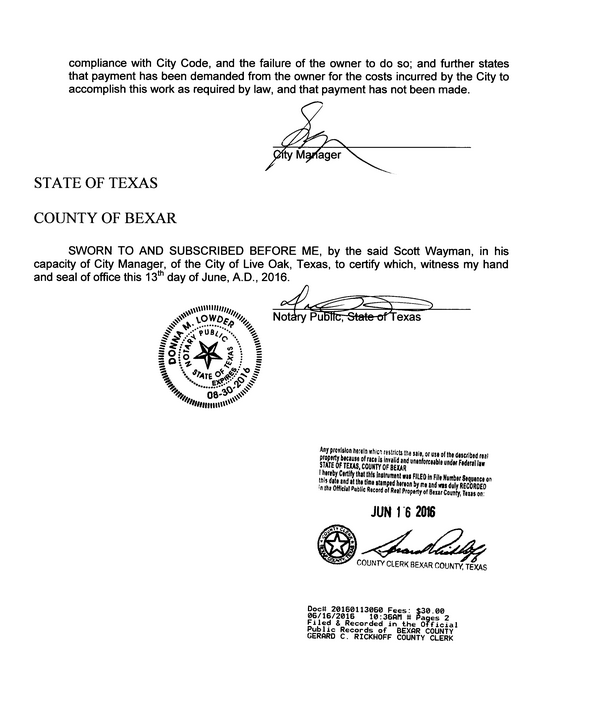
Both the City of Live Oak and City of San Antonio have placed liens against owners Wade E. Bedell, Jr, Maumoud M. Zahreal, and Prabhjot Bhinder for unpaid liens, administrative cost of on-site inspections, record keeping, and billing. The owners owe the City of Live Oak and City of San Antonio close to $8,000 dollars in unpaid liens and fees. These fees have yet to be paid off. Meanwhile both cities continue to impose liens against the owners.
Because of the high amount of unpaid liens and fees, Maumoud M. Zahreal sold the property to Prabhjot Bhinder on a general warranty deed. Both of the owners plan on building more quadraplexes on the surrounding property. For now these quadraplexes sit under construction. Orange plastic construction fencing now surrounds the perimeter of the quadraplexes property. Prabhjot Bhinder is the current owner of these quadraplexes. Prabhjot Bhinder is a company and person.